Best Gut Health Supplements for Men: What to Look For on the Label
Quick Answer: How to Judge a Men's Gut Formula
Judge it on four numbers, not on the packaging. The best gut health supplements for men name each bacterial strain and state its CFU count separately, list a fibre or prebiotic amount you can compare against published research, show metabolic extras in milligrams rather than hiding them in a proprietary blend, and carry a suggested use you will realistically follow. If a label withholds any of those, you cannot check it against the evidence — and neither can anyone else.
- Check first: named strains with a CFU count each, not a vague "probiotic blend".
- Check second: the fibre amount, and how it compares with the grams used in trials.
- Check third: whether the metabolic actives are at studied amounts or at token ones.
What "gut health" actually means on a supplement label
The phrase covers at least three different things, and products blur them deliberately. The first is the microbiome itself: the community of bacteria in the large intestine, which supplements try to influence with live cultures (probiotics) or with the fibres those bacteria feed on (prebiotics). The second is the gut barrier, the mucus-and-cell lining that separates intestinal contents from the bloodstream, which is where a strain like Akkermansia muciniphila lives. The third is digestive comfort — bloating, regularity, that heavy feeling after a large meal — which is what most buyers are actually shopping for.
Those three targets need different ingredients and have different quality of evidence behind them. A formula built for regularity is mostly fibre. A formula aimed at the barrier is mostly specific strains. A formula aimed at metabolism leans on botanicals and compounds like berberine or alpha lipoic acid. Products aimed at men frequently claim all three at once, which is possible in principle, but only if the amounts hold up. That is the thing to check, and it is checkable in about ninety seconds.
Rule one: named strains, and a CFU count for each
A probiotic's effects are strain-specific. Bifidobacterium breve is not interchangeable with Lactobacillus rhamnosus, and neither behaves like Akkermansia muciniphila. A label that says "proprietary probiotic blend, 10 billion CFU" tells you nothing useful, because the 10 billion could be 9.9 billion of the cheapest strain and a rounding error of the one you were interested in.
So the first filter is simple: does the panel name each organism at genus and species level, and does it give a CFU figure beside each one? Two well-specified strains at a modest count are more assessable than eight strains hidden behind one total. Second, look for a potency statement. "CFU at time of manufacture" and "CFU through end of shelf life" are different promises; live cultures decline over time, particularly in warmth. Third, check storage instructions. A shelf-stable capsule that asks to be kept cool and dry is normal; one that needs refrigeration and arrived in a hot van is a different proposition.
A CFU number you can trace to a named strain is worth more than a bigger number attached to a blend. The count only means something once you know what is being counted.
Rule two: read the fibre line honestly
This is where most gut formulas quietly fall short, and it matters more for men than the marketing admits. Average fibre intake in most Western countries sits well below the recommended daily amount, and men in particular tend to eat less of it relative to how much they eat overall. Fibre is also the ingredient with the most boring, most reliable evidence: it feeds the bacteria already in your colon, it slows gastric emptying, and soluble forms increase the feeling of fullness.
The catch is scale. Fibre works in grams, while capsules deliver milligrams. Glucomannan, the soluble fibre from konjac root, is the clearest example: European regulators accepted a weight-management claim for it at three grams a day, taken as three separate one-gram doses with water before meals, and specifically within an energy-restricted diet. Three grams is roughly six standard capsules of pure fibre. Any one-capsule-a-day product containing 50 or 100 milligrams of a fibre extract is nowhere near that figure, and an honest guide says so rather than implying the ingredient's whole research base transfers to the smaller amount.
That does not make small fibre inclusions worthless — they contribute to a formula alongside food — but it does mean a supplement is not where you should get your fibre. Oats, beans, lentils, berries and vegetables are, and no capsule competes with them on grams per unit of effort or cost. Where a fibre capsule does earn a place is appetite rather than total fibre intake, a distinction we work through in our comparison of the best appetite suppressant supplements for 2026.
Want a formula that shows every milligram?
If you are comparing gut health supplement brands and want to see the full Supplement Facts panel before you decide where to buy weight loss supplements, start with the label rather than the sales copy.
See the Official Trimoryn OfferRule three: metabolic extras, and the dose gap
Formulas aimed at men usually bolt metabolic ingredients onto the gut base: berberine, cinnamon bark extract, alpha lipoic acid, turmeric, resveratrol, chromium. Several of these have real research behind them. The problem is almost never whether the ingredient has been studied — it is whether the amount in the capsule resembles the amount in the study.
Berberine is the sharpest illustration. Clinical trials generally use around 500 mg two or three times daily, so roughly 1,000 to 1,500 mg a day, and that is the amount behind the reported improvements in glucose and lipid markers. Combination formulas routinely include 10 to 50 mg. That is a supporting inclusion, not a replication of the trial protocol, and any product implying otherwise is overreaching. The same pattern repeats with curcumin, resveratrol and alpha lipoic acid: studied at hundreds of milligrams, included at tens.
None of this means combination products are pointless. It means you should read them as combinations — a modest push on several pathways at once, taken alongside diet and training — rather than as a single-ingredient study in a bottle. Our companion piece on what the berberine and Akkermansia research actually shows goes through that evidence in more detail.
A checklist you can run in a shop or a browser tab
Below is the short version of everything above, in the order it is worth checking. The right-hand column is the failure mode — the thing a weaker product does instead.
| What to check | Good sign | Red flag |
|---|---|---|
| Strains | Genus and species named, CFU listed per strain | "Proprietary probiotic blend" with one total |
| Potency | CFU guaranteed through end of shelf life | No potency statement at all |
| Fibre | Amount printed, compared honestly with trial doses | Grams of research implied by milligrams in the capsule |
| Metabolic actives | Milligrams per serving for every named ingredient | Blend totals that hide the split |
| Serving size | Stated capsules per day and servings per container | Bottle count advertised without daily dose |
| Claims | Support-style wording, disclaimers present | Disease claims, "melts fat", guaranteed numbers |
| Manufacturing | Named facility standards, contact details, returns policy | No company address, no refund terms |
How the best gut health supplements for men stack up, ingredient by ingredient
It helps to hold ingredients in tiers rather than treating every line on a panel as equally supported. Dietary fibre sits in the strongest tier: decades of nutritional evidence, clear mechanisms, and effects on satiety and regularity that show up consistently, though at food-level doses. Berberine sits next: a genuinely substantial clinical literature on glucose and lipid markers, with modest, secondary effects on body weight, all at doses far above typical supplement inclusions.
Then come the strains. Bifidobacterium breve is a well-characterised, widely used species with a good safety record and strain-specific research behind particular preparations. Akkermansia muciniphila is the newest and most interesting: repeatedly found at lower levels in people with obesity and metabolic dysfunction, and tested in a small 2019 human pilot published in Nature Medicine that reported improvements in some metabolic markers with a good safety profile. That study is a starting point, not a conclusion, and it used a substantially larger daily cell count than the one billion CFU many blended formulas contain.
The botanicals — cinnamon bark, mangosteen, prickly pear, turmeric, resveratrol — are the weakest tier for weight specifically. There are mechanistic studies and some small human data, but effect sizes are small, results are mixed, and doses vary wildly between trials. Calling them supportive is fair. Calling them proven is not.
What a men's gut supplement cannot do
This is the section most product pages skip, so here it is plainly. No gut or metabolic supplement is a treatment for any medical condition; these are foods in a legal sense, not medicines, and nothing on a panel like this diagnoses, treats, cures or prevents disease. Persistent digestive symptoms — blood, unexplained weight change, pain that wakes you, a sudden change in bowel habit lasting weeks — are a reason to see a doctor, not a reason to buy a capsule.
Nor will a capsule out-argue your diet. Every credible body that has examined weight-loss supplements, including the US National Institutes of Health, reaches the same conclusion: measured effects are small at best, the evidence is often low quality, and a calorie-controlled diet plus physical activity is what actually moves body weight. A supplement can support that; it cannot substitute for it.
There are practical cautions too. Berberine has real drug interactions and can lower blood sugar, so it needs a conversation with a pharmacist or doctor if you take medication. Concentrated fibres should be taken with plenty of water. Live cultures may cause a few days of wind or looser stools while things settle. And anyone who is immunocompromised should get medical advice before taking live bacteria at all. The checklist itself applies whoever is holding the bottle, although the priorities shift with age and life stage, which we take from a different angle in supplement choices for women over fifty.
Putting the checklist against a real panel
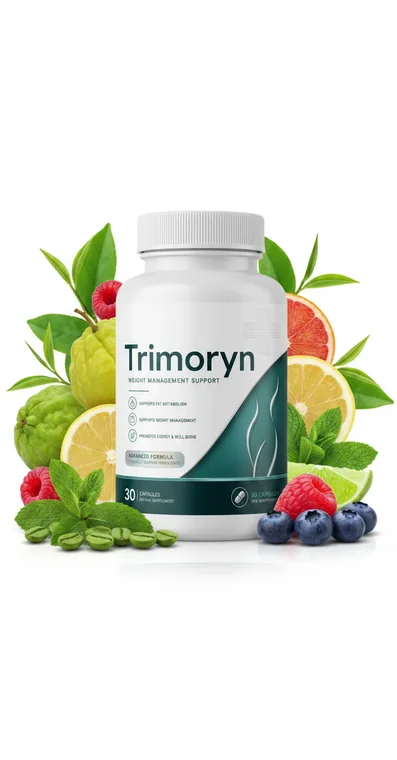
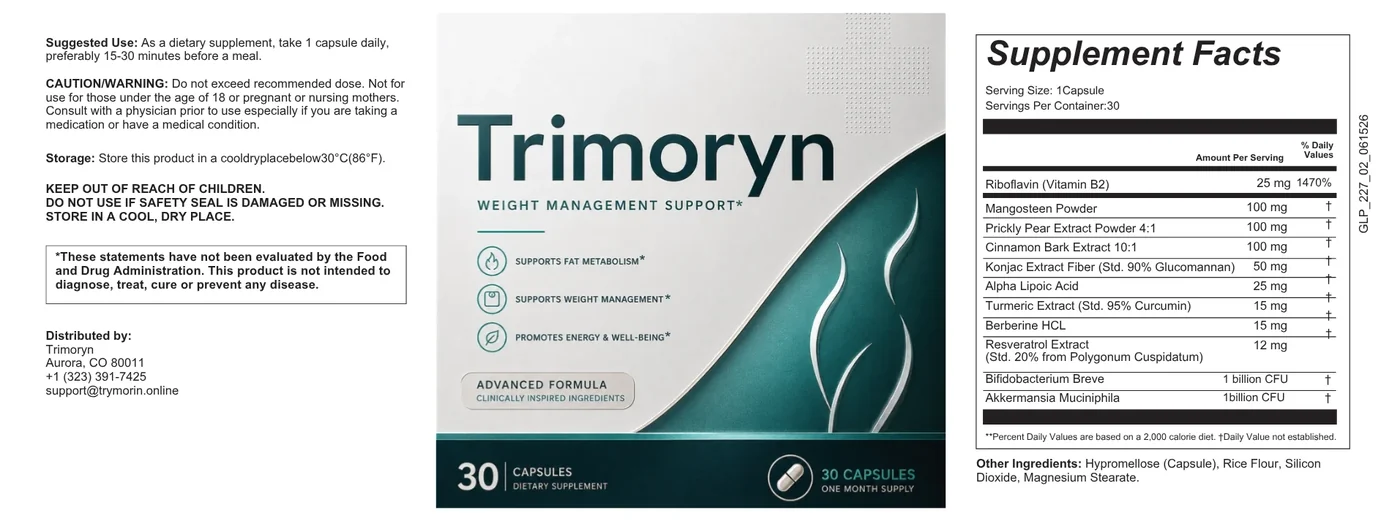
To make this concrete: the Trimoryn formula we cover on this site is a one-capsule-a-day product that names both of its strains, Bifidobacterium breve and Akkermansia muciniphila, at one billion CFU each, and prints every botanical in milligrams — cinnamon bark extract and prickly pear at 100 mg, konjac fibre standardised to 90% glucomannan at 50 mg, alpha lipoic acid at 25 mg, turmeric and berberine at 15 mg, resveratrol at 12 mg, alongside riboflavin.
Run that through the checklist and you get a mixed, honest picture. It passes the transparency tests: strains named, CFU stated per strain, no proprietary blend, serving size and servings per container printed, suggested use given as one capsule 15 to 30 minutes before a meal. It does not pretend to hit trial-level doses of berberine or glucomannan, and neither should any reader assume it does. That is roughly what a broad-spectrum daily formula looks like when you read it accurately: several small nudges plus two named strains, meant to sit alongside the diet and training that do the heavy lifting.
Medical note: this article is general information, not medical advice. Speak to a healthcare professional before starting any supplement, especially if you are taking medication or managing a health condition — berberine in particular interacts with several drugs and can lower blood sugar.
Frequently asked questions
What should men look for in a gut health supplement?
Look for four things on the Supplement Facts panel: named strains rather than a vague blend, a CFU count stated per strain, a fibre or prebiotic amount you can compare against published research, and metabolic extras listed at amounts you can check. If any of those four is missing or hidden inside a proprietary blend, you cannot judge the product against the evidence, and neither can anyone else.
Do men need a different gut formula from women?
Not in any strong biological sense. The strains and fibres studied for gut and metabolic support are the same regardless of sex, and most products marketed to men differ mainly in packaging. What can differ is context: men on average eat less fibre than the recommended daily amount and carry more weight around the middle, so fibre content and metabolic support are often the more useful things to compare.
How many CFU does a gut supplement need?
There is no universal number. Benefits in trials are strain-specific and dose-specific, with studied daily amounts ranging from around one billion CFU to tens of billions depending on the strain and the outcome measured. A higher CFU count is not automatically better, but a product that does not state CFU per strain at all cannot be compared with any study.
Can a gut health supplement cause weight loss on its own?
No. No supplement replaces a calorie-controlled diet and regular activity, which are what actually drive weight change. Gut and metabolic ingredients are studied as support alongside those habits, and the measured effects in trials are small. Treat any product promising results without diet or exercise changes as a marketing claim, not a finding.
Scientific references
- NIH NCCIH — Probiotics: What You Need To Know
- NIH Office of Dietary Supplements — Dietary Supplements for Weight Loss
- Harvard T.H. Chan School of Public Health — Fiber
- Mayo Clinic — Dietary fiber: Essential for a healthy diet
- Minami J. et al. — Effects of Bifidobacterium breve B-3 on body fat reductions in pre-obese adults: a randomized, double-blind, placebo-controlled trial, Bioscience of Microbiota, Food and Health (2018)

See the full Trimoryn panel
Two named gut strains, konjac glucomannan fibre and metabolic botanicals — every amount printed, with the current Trimoryn price and guarantee shown on the official page.
Check Availability